Concrete · Intermediate
How to Calculate Concrete Volume for Columns and Footings
Cylinder and box volume math for deck footings, fence posts and pier columns — with a full worked example.
- • Tape measure
- • Post hole digger or auger
- • Level
- • Wheelbarrow or mixer
- • Shovel
- • String line
- • Concrete mix or ready-mix
- • Tube forms (Sonotube)
- • Rebar
- • Post base anchors
- • Gravel
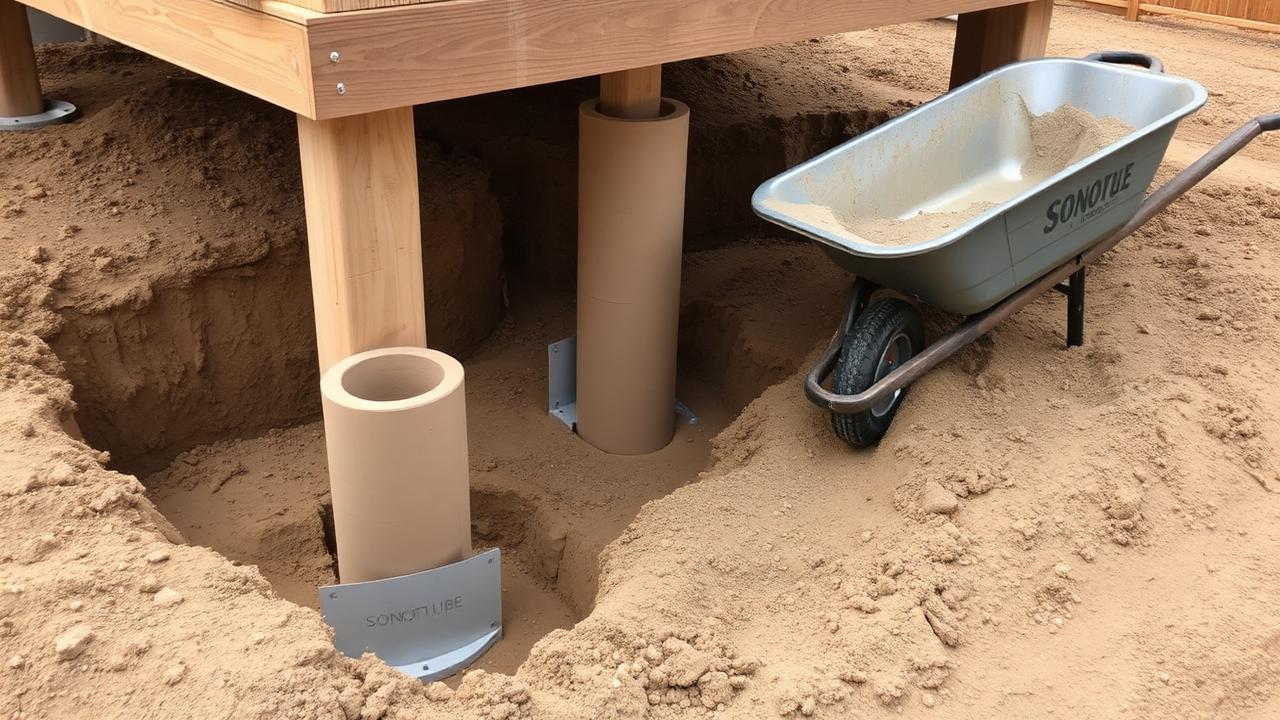
Two shapes cover almost every footing
A round pier is a cylinder: volume = π x radius² x depth. A square or rectangular pad footing is a box: volume = length x width x depth. Everything else — bell-bottom piers, stepped footings — is a combination of the two.
Work in feet throughout. Convert inches by dividing by 12 before you multiply anything.
Cylinder volumes at a glance
Per foot of depth, a round footing consumes:
| Diameter | Cu ft per ft of depth | 80 lb bags per ft | Typical use |
|---|---|---|---|
| 8 in | 0.35 | 0.6 | Fence posts, light pergola |
| 10 in | 0.55 | 0.9 | Deck piers, small posts |
| 12 in | 0.79 | 1.3 | Standard deck footing |
| 16 in | 1.40 | 2.3 | Heavy deck / porch column |
| 18 in | 1.77 | 3.0 | Beam pier, carport post |
| 24 in | 3.14 | 5.2 | Structural column, addition pier |
Frost depth drives your quantity
Footing depth is set by your local frost line, not by preference. Southern Florida and coastal California may allow 12–18 inches; the Upper Midwest and northern New England commonly require 42–60 inches. Doubling depth doubles concrete, so confirm the local requirement before you estimate.
Step-by-step
- 1
Confirm footing size and depth with your building department
Call or check the online code page for two numbers: frost depth and minimum bearing area. Most jurisdictions publish a table matching tributary load to footing diameter. A typical 12x16 residential deck needs 12-inch piers at frost depth with 16-inch bell bottoms or pad footings in poor soil.
- 2
Convert every dimension to feet
A 12-inch tube is 1 ft in diameter, so radius = 0.5 ft. A 42-inch depth is 42 ÷ 12 = 3.5 ft. Doing this before you touch the formula eliminates the most common source of order errors.
- 3
Calculate one pier
Volume = π x r² x depth = 3.1416 x 0.5² x 3.5 = 2.75 cubic feet. At 0.60 cu ft per 80 lb bag, that is 4.6 bags — call it 5 bags per pier.
- 4
Multiply by the pier count and add the pads
Nine piers x 2.75 cu ft = 24.75 cubic feet, or 0.92 cubic yards. If code requires a 24 x 24 x 8 inch pad under each pier, add 2 x 2 x 0.667 = 2.67 cu ft each, another 24 cubic feet — which nearly doubles the pour to 1.8 cubic yards.
- 5
Add waste and decide bags vs truck
Add 10% for over-dug holes and soil sloughing: 1.8 x 1.10 = 2.0 cubic yards. That is 90 bags of 80 lb mix — well past the practical DIY limit. Order ready-mix and place it with a wheelbarrow or a pump.
- 6
Set rebar and anchors before the pour
Most codes require two to four vertical #4 bars in piers over 12 inches in diameter, with 3 inches of concrete cover. Set post base anchors in the wet concrete while it is still plastic, check them against a string line, and re-check after 20 minutes — they drift.
- 7
Cure before loading
Concrete reaches roughly 70% of design strength in 7 days and 100% at 28 days. You can set posts after 48 hours in warm weather, but do not load the structure with framing and decking until day 7 minimum.
Related calculators
Was this guide helpful?
People also searched
Safety note: this guide is educational. Always follow local building codes, pull required permits, and hire a licensed pro for structural, electrical, gas or plumbing work when in doubt.
More guides
How to Install a Pre-Hung Interior Door
Shimming, plumbing and hanging a pre-hung door so it latches cleanly and stays where you leave it.
Read FramingHow to Frame a Basement Wall
Moisture control, wall placement, bottom plates on concrete and the framing sequence for a basement finish that lasts.
Read PlumbingHow to Replace a Kitchen Faucet
A 60–90 minute swap done properly: shutoffs, the basin wrench problem, supply lines and leak testing.
ReadRelated articles
How to Calculate Cement Bags for 1,000 Sq Ft (Slab, Plaster and Masonry)
The volume-to-bag method worked through for a slab, wall plaster and block mortar — with the mix-ratio table and the mistakes that double your order.
Read ConcreteHow Many 80lb Bags of Concrete Do I Need for a 10x10 Slab?
The short answer is 56 bags for a 4-inch slab — here is the simple math, the waste allowance, and when bagged mix stops making sense.
Read ConcreteConcrete vs Pavers: Which Is Better for Your Driveway?
Cost, durability, maintenance and curb appeal for the two most common driveway materials.
Read