Concrete
How Many 80lb Bags of Concrete Do I Need for a 10x10 Slab?
The short answer is 56 bags for a 4-inch slab — here is the simple math, the waste allowance, and when bagged mix stops making sense.
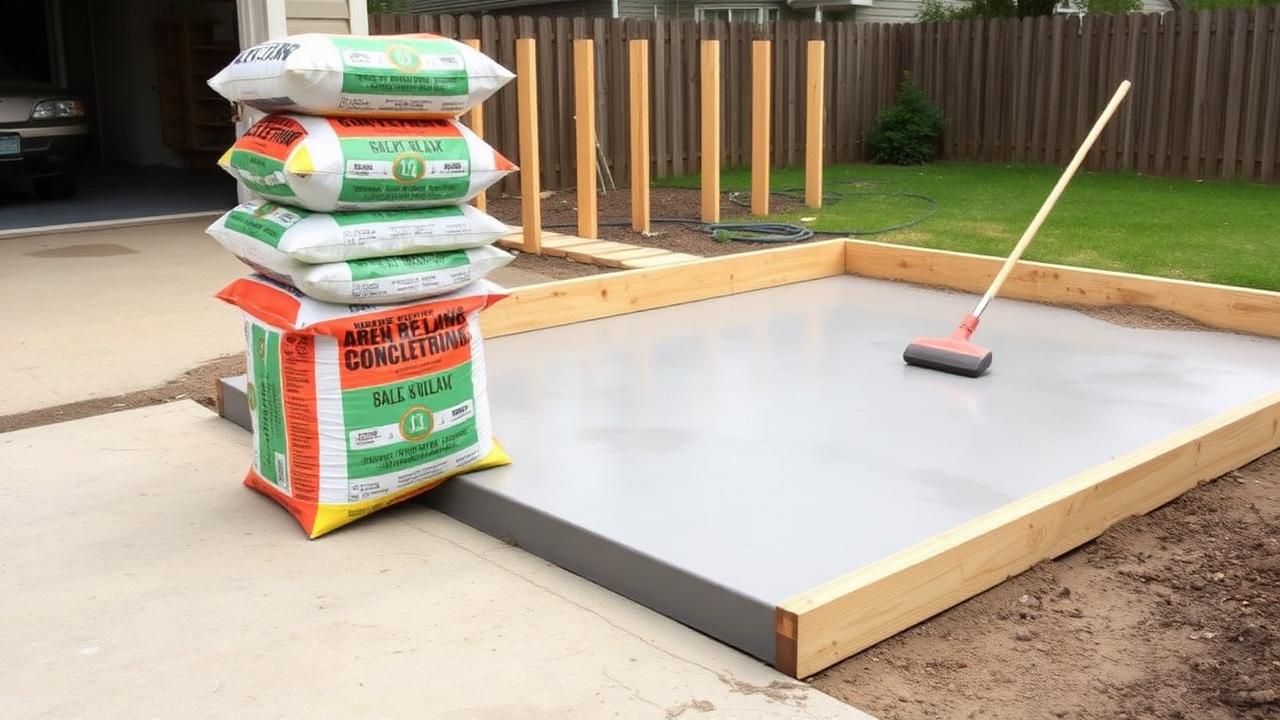
The short answer
A 10 ft x 10 ft slab poured 4 inches thick needs 1.23 cubic yards of concrete. One 80 lb bag of pre-mixed concrete yields 0.60 cubic feet, so you need 56 bags with no waste, or 60–62 bags once you add the standard 5–10% allowance for spillage, over-dig and uneven subgrade.
That is roughly 4,800 lbs of material — about two pickup-truck loads. Before you commit, read the last section: at this size, ready-mix delivery is usually cheaper and dramatically less work.
| Slab thickness | Cubic feet | Cubic yards | 80 lb bags | With 10% waste |
|---|---|---|---|---|
| 3 in | 25.0 | 0.93 | 42 | 46 |
| 4 in | 33.3 | 1.23 | 56 | 62 |
| 5 in | 41.7 | 1.54 | 70 | 77 |
| 6 in | 50.0 | 1.85 | 84 | 92 |
Step 1 — Convert thickness to feet
Every concrete formula lives in feet, so the first move is converting inches to a decimal: divide by 12. A 4-inch slab is 4 ÷ 12 = 0.333 ft. A 5-inch slab is 0.417 ft. This one step is where most DIY estimates go wrong — people multiply by 4 instead of 0.333 and order eight times too much concrete.
Step 2 — Calculate volume in cubic feet
Volume = length x width x thickness. For our slab: 10 ft x 10 ft x 0.333 ft = 33.3 cubic feet.
If your slab is not a clean rectangle, break it into rectangles, calculate each one, and add them together. An L-shaped patio is just two rectangles that share an edge.
Step 3 — Convert to bags (or yards)
Bag yields are printed on the sack and are consistent across Quikrete, Sakrete and Home Depot house brands:
- 40 lb bag = 0.30 cu ft → 111 bags for a 4-inch 10x10 slab
- 50 lb bag = 0.375 cu ft → 89 bags
- 60 lb bag = 0.45 cu ft → 74 bags
- 80 lb bag = 0.60 cu ft → 56 bags
- Ready-mix truck: divide cubic feet by 27 → 1.23 cu yd (order 1.5 yd)
Step 4 — Add a realistic waste factor
Add 5% on a flat, well-formed slab over compacted gravel. Add 10% if your subgrade is soft soil, the excavation is uneven, or you are pouring against an existing structure. Concrete finds every low spot, and running short mid-pour creates a cold joint that will crack.
For our 10x10 example: 56 bags x 1.10 = 62 bags. Buy 62, return the unopened ones — most retailers accept returns on unopened bags with a receipt.
When bagged mix stops making sense
The practical ceiling for bagged concrete is about 1 cubic yard, or roughly 45 bags. Beyond that you are mixing for hours, and the first section starts curing before the last one is placed.
A 10x10 slab is right at the line. In 2026, 62 bags of 80 lb mix runs $340–$420 at big-box pricing. A short-load ready-mix delivery of 1.5 yards typically costs $480–$650 including the short-load fee — more money, but the pour finishes in 20 minutes with a uniform, monolithic slab. If you are pouring alone or in hot weather, pay for the truck.
Common mistakes to avoid
These are the errors that turn a Saturday project into a demolition job:
- Ordering by weight instead of yield — a 'ton of concrete' is meaningless without the bag yield
- Forgetting the 4-inch gravel base, which changes your excavation depth but not your concrete volume
- Skipping control joints — cut them at 8–10 ft intervals, one-quarter of slab depth
- Mixing too wet: excess water is the single biggest cause of surface scaling and low strength
- Not accounting for thickened edges; a 12-inch turndown around a 10x10 slab adds ~4 cu ft (7 extra bags)
Tools & guides for this project
Concrete Calculator
Free calculator
Concrete Block Calculator
Free calculator
Foundation Calculator
Free calculator
Footing Calculator
Free calculator
How to Calculate Concrete Volume for Columns and Footings
9 min read
The Retaining Wall Block Calculator Guide: Standard Sizes & Estimating Rules
10 min read
Understanding Rebar Spacing: How Much Steel Reinforcement Do You Need?
9 min read